
Carsten Cramer Takes Command at Borussia Dortmund and Demands a New Direction
Authored by player.cash, 15 Apr 2026
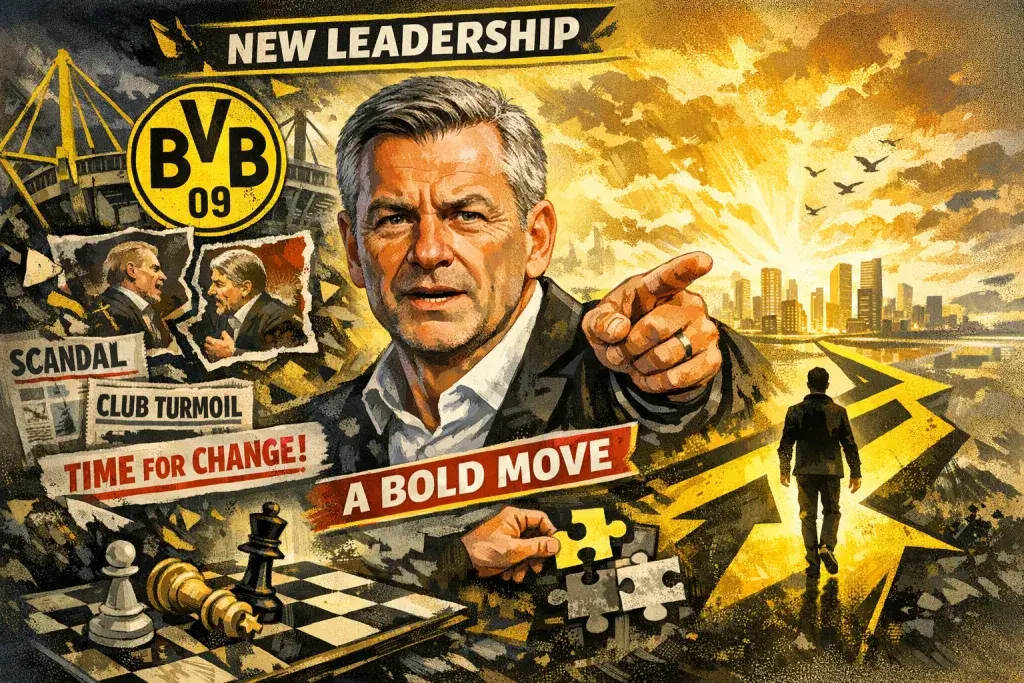
A new figure has taken charge of Borussia Dortmund's strategic future, and he is already speaking with a directness the club's supporters have not heard in some time. Since late November, Carsten Cramer — 57 years old, a BVB insider since 2010 — has assumed the role of chief executive, extending his existing responsibilities across marketing, sales, digitalisation and internationalisation to now include communications and strategy. Within weeks of taking on the expanded brief, his words and decisions have begun to signal something more than a routine transition at the top.
A Leadership Shift Arriving at a Difficult Moment
Cramer's ascent did not occur in calm waters. Borussia Dortmund has faced a turbulent period: an abuse scandal involving a former senior official, a publicly acrimonious dispute between incumbent president Dr Reinhold Lunow and his challenger Hans-Joachim Watzke, and underwhelming on-pitch results in the preceding seasons have all left the club's image bruised. Cramer has not attempted to soften this reality. His own assessment — that BVB did not emerge with credit from the abuse affair — was delivered without qualification.
This willingness to speak plainly marks a departure from the institutional defensiveness that had characterised the club's public posture in recent years. For large organisations navigating reputational damage, frank internal acknowledgement is often the prerequisite to credible reform. Cramer appears to understand that. The question is whether the rhetoric translates into structural change.
The Ole Book Appointment and What It Reveals
The most concrete early signal of Cramer's intentions was the appointment of Ole Book as sporting director — a decision that arrived swiftly and surprised much of the football world. Book comes from SV Elversberg, a second-division club with limited profile at the highest level of European football administration. The unconventional choice was deliberate. Cramer framed it explicitly: not a reset, but, in his words, "a major update." He described Book as someone who "really represents the new BVB well" and called him "the missing piece of the puzzle."
Whether this proves to be inspired or reckless will only become clear over time. What it does confirm is that Cramer is not governing by consensus or convention. Appointing a relatively untested executive to one of the most scrutinised sporting director roles in German football carries risk — but it also signals a genuine willingness to break with the patterns that have produced stagnation. That willingness itself has value, particularly for a club whose identity had begun to feel calcified.
The Forward-Looking Posture and What It Implicitly Rejects
Cramer's remark that he is "not a big fan of always looking to the past, because looking back too much eventually leads to a stiff neck" was widely noted. Whether aimed directly at Watzke or not, it carries unmistakable meaning. Watzke's era was defined by frequent reference to the club's historic achievements — the Bundesliga titles of 2011 and 2012, the Champions League final of 2013 — as a substitute for a compelling contemporary narrative. That backward orientation served a purpose during periods of consolidation, but it also became a kind of institutional inertia.
Cramer's language positions him differently. Phrases like "major update" and "big plans" are not merely rhetorical; they reflect a particular theory of organisational renewal. For a club of Dortmund's scale — one that occupies a unique cultural position in German football as the club of the working city, the yellow wall, the standing terraces — the stakes of getting this transition right extend well beyond results.
Ambition Stated. Delivery Awaited.
Cramer has also pointed to what he sees as a shift in competitive momentum. With Dortmund accumulating points at a rate not seen in several seasons and edging towards Champions League qualification with relative comfort, there is at least a functional base from which to build. The criticism he has absorbed — that the club too often relies on familiar internal networks, lacks creative thinking in squad construction, and has allowed its once-distinctive identity to blur — is not new. Hearing it acknowledged from within the executive structure, however, is.
Leadership transitions at major institutions frequently produce statements of intent that dissolve under the pressures of incumbency, budget constraints, and internal resistance. Cramer has the advantage of institutional knowledge — fourteen years at BVB give him an understanding of where the blockages lie. His challenge now is to use that knowledge not to protect the existing structure but to reshape it. The fans listening closely are not short of patience, but they are short of reasons to believe. Cramer is, at minimum, providing those reasons again. What follows will determine whether they were warranted.